When does the car insurance renew? Which contractor quoted what for the bathroom? Where is the manual for the kids’ remote control car? In our family, all of that lived in one head. Mine.
famstack 0.3 is the release where the document archive starts becoming a family brain.
A couple of weeks ago a thread blew up on Reddit asking: is there an Immich for documents? Something self-hosted that does for the family documents what Immich does for the photos. The comments all pointed to Paperless-ngx, and that’s the right answer. famstack ships it for exactly that reason. But filing the paperwork was never the whole problem.
We got more. What if someone curated a wiki for your family life? Facts, documents, bookmarks, voice notes, topics. Everything in one place, for you to view and search. Pages that stay current without anyone in the family maintaining them.
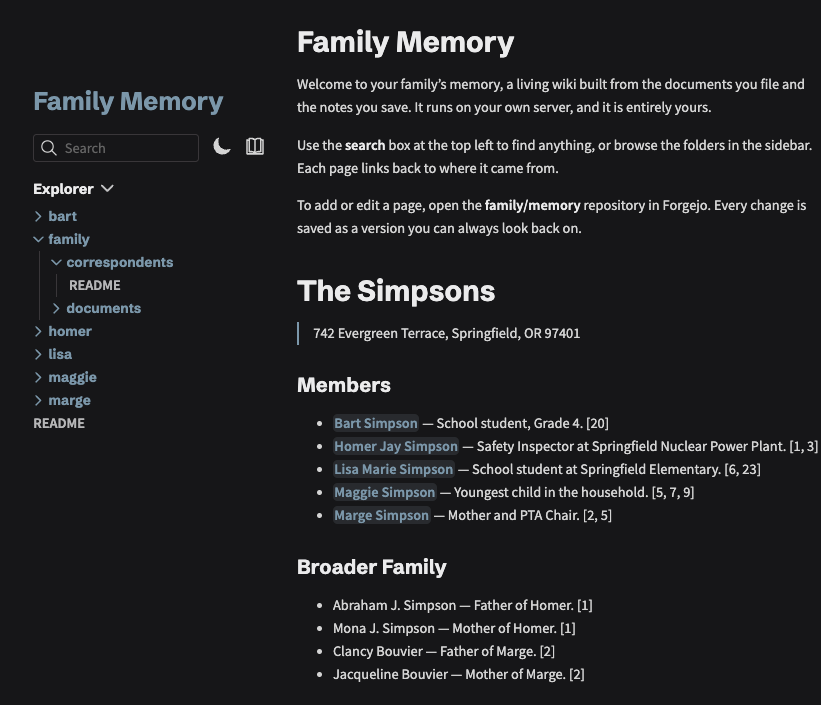
The wiki home page, generated from the filed documents. The demo family lives at 742 Evergreen Terrace.
At the center of 0.3 is a new stacklet: memory. It’s the part of the household brain that was missing. It holds your family’s vocabulary, facts, and wiki as a git repository on your own Mac. The archivist writes into it, the wiki is generated from it, question answering reads from it.
In 0.3:
- A family wiki, generated from what you file. ↓
- Answers with sources in the family chat. ↓
- Voice memos that come back as clean, searchable notes. ↓
- Topic rooms: the room is the filing system. ↓
- A vocabulary your family owns: correspondents, topics, synonyms. ↓
- Tons of bug fixes and under-the-hood work. ↓
42 seconds of clicking through the wiki. Everything on these pages came out of the paperwork.
I tagged 0.2.1 back in May. Since then over 130 commits piled up on a beta branch, and we’ve been running all of it on our own family server the whole time. Two of those weeks I was on vacation with the family and did not touch a thing. Recommended.
#Building on top of the 0.2 foundation
0.2 files documents. Drop a photo of a letter into the family chat, the archivist OCRs it, tags it, files it into Paperless. That’s useful on its own, and it has been working in our house for months. But this never was the end of the story. It is the beginning.
The documents just sit there. Storing them is good, but the actually useful part is the implicit knowledge inside them: the renewal dates, the quotes, the manuals, the numbers you need exactly once a year.
0.3 extracts facts out of these documents and curates your family wiki for you. All your family knowledge centralized in your privately owned Wikipedia about you and your family: your cars, your contracts, your interests, your projects.
And there is more: 0.3 introduces the concept of “captures”. Captures are bookmarks or notes, things that spin in your head. Paste a URL for later, or send a voice message, and it gets filed automatically in your wiki.
The whole pipeline in one picture:
               Matrix family chat
       scans · voice memos · links · notes
                        │
                        ▼
                  ╭───────────╮
                  │ archivist │  OCR · transcribe · read
                  ╰───────────╯
                        │
                        ▼
                   categorize
       topics · correspondents · synonyms
                        │
          ┌─────────────┴──────────────┐
          ▼                            ▼
   ╭─────────────╮              ╭─────────────╮
   │  Paperless  │              │ memory repo │  opens as an
   │  originals  │              │ facts · git │  Obsidian vault
   ╰─────────────╯              ╰─────────────╯
          └─────────────┬──────────────┘
                        ▼
                  family wiki
    a page per person · topic · organization
                        │
                        ▼
                ask in the chat
             answers, with sources
Everything enters through the chat, and everything comes back out through it. The middle is just plumbing your family never has to look at.
#A vocabulary your family owns
The brain is a git repository, which famstack already runs locally (Forgejo). It contains an ontology, the topics and document types your family uses, with synonyms in English and German. And it contains one page per organization you deal with:
---
kind: correspondent
canonical: Springfield Insurance
aliases:
  - "Springfield Ins. Group"
  - "SIG Claims Department"
topics: [insurance, vehicle]
---
The classifier reads these pages before it classifies a new document. So whatever the letterhead says this month, the filing lands on the canonical name. If something gets misclassified, you edit the page, commit, and the next document gets it right. git log on the brain repo shows you what your server has learned over time. A bad change is one revert away.
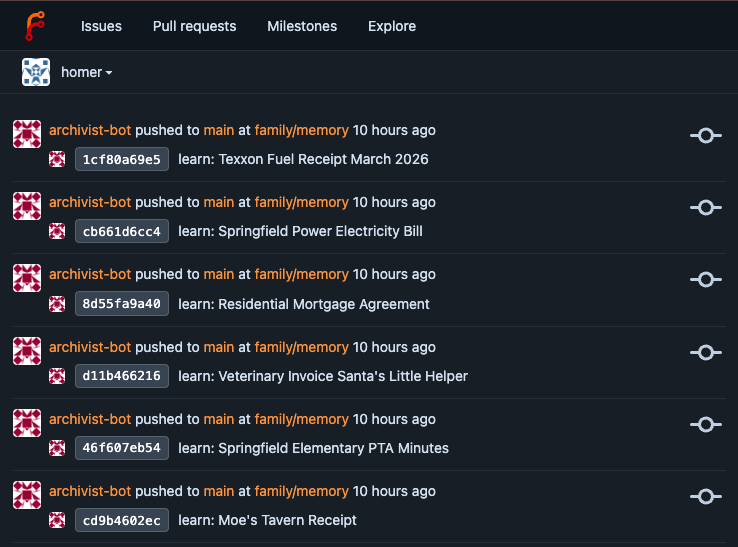
Every filing is a commit. The push log doubles as the server’s learning history.
The seed comes with 34 topics and 19 document types. That covers what arrives in our mailbox, and probably most of yours. From there the vocabulary grows with your family.
#A family wiki, generated from your documents
This did not exist in 0.2 at all, and it’s the reason 0.3 is taking longer than planned.
The server generates a wiki out of everything that gets filed. A home page for the household. A page per family member. A page per correspondent and per topic. The content comes from the filed documents, the saved articles, the voice notes. New filings update the affected pages.
Technically it’s plain Markdown in a git repo on your own Mac, and the format is Obsidian-compatible. You can browse it in your browser with full-text search, backlinks, and a graph view. You can also open the vault in Obsidian and edit pages by hand. Generated sections sit inside markers, so hand edits survive the next regeneration. Every change is a commit.
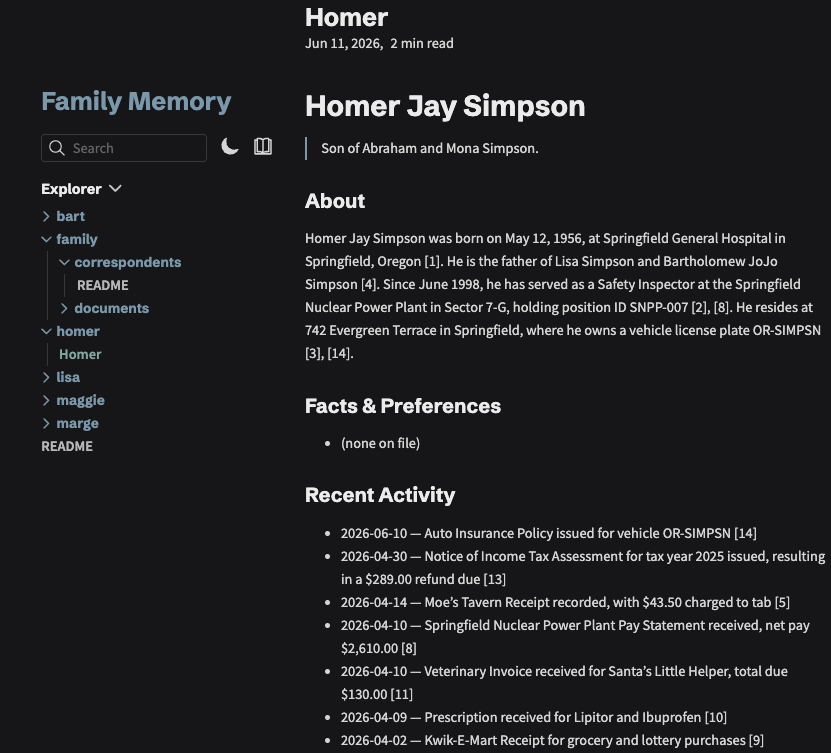
Homer’s page. Safety Inspector, $43.50 at Moe’s, every line cites the document it came from.
If you follow the AI space, you might recognize the pattern. Andrej Karpathy published the llm-wiki idea earlier this year: an LLM incrementally builds and maintains an interlinked Markdown wiki from raw source material. His framing was “Obsidian is the IDE, the LLM is the programmer, the wiki is the codebase.” Half the AI internet ran with it and is now building second brains out of a markdown vault and an agent. The famstack wiki is that idea applied to a household: a family second brain, not just one for whoever set up the server. The source material is the paperwork and chat that flows through your server anyway, and the whole thing runs on your own Mac.
I’ve wanted something like this for years: a knowledge base of our household that stays current without me maintaining it. Now it builds itself from paperwork we had to deal with anyway. I can dump my thoughts and ideas and links about different topics and it gets tagged, summarised and stored automatically for me.
#Getting things in
A knowledge base needs input, and the input paths have to be effortless or they won’t be used. Three ways in:
Voice memos. Send one to the family chat and it comes back as a clean, punctuated transcript, filed in the vault as a searchable note. The original audio stays in the chat. The part I’m really after is not built yet: wiring in the memories room, so the funny things the kids say become family stories in the wiki. A growing chronicle of the family years, something we’ll reread in ten years. 0.3 lays the transcription foundation for it.
Links and text. Paste a URL into your notes room and the archivist reads the page and files a summary with consistent tags. Paste a block of text and it keeps your words. My browser bookmarks folder has been retired.
Topic rooms. Create a Matrix room named Topic: Garden Project and invite the bot. Every note, link, and scan dropped in that room is filed under that topic and feeds the topic’s wiki page. German households can name the room Thema:, both work.
#Asking questions in the chat
The knowledge comes back out where the family already is. End a message with ?:
homer: when does our car insurance renew?
archivist: Your car insurance renews on March 1st [1]. The last premium notice arrived in November [2]. [1] Springfield Insurance renewal notice (2025-11-12) [2] Springfield Insurance premium adjustment (2025-11-03)
(Yes, the demo family is the Simpsons. The repo ships a demo document set addressed to 742 Evergreen Terrace, birth certificates included.)
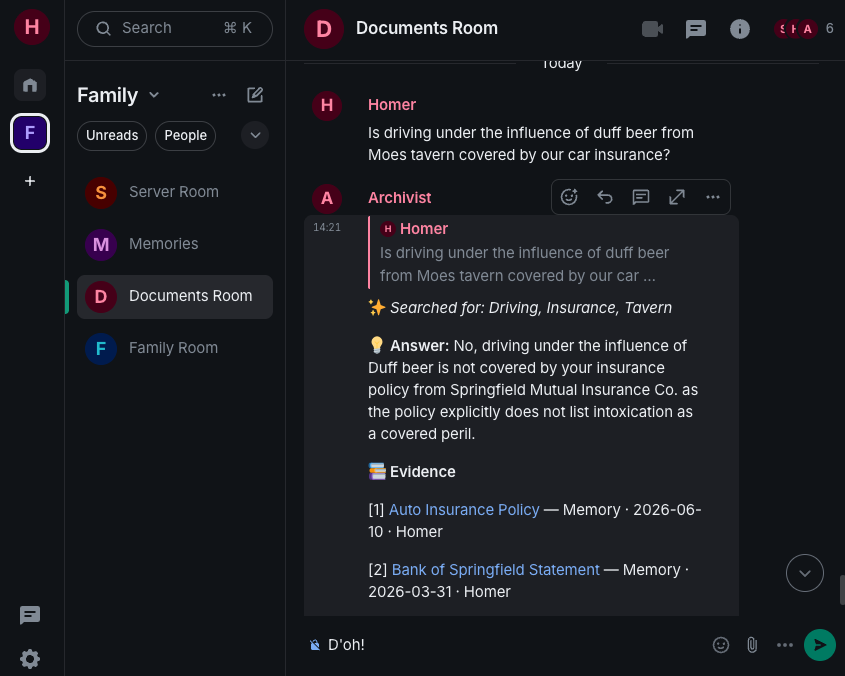
Asked and answered, with sources. No, Duff-related incidents are not covered.
You get a short answer with citations. If the document summaries aren’t enough, the bot says so, reads the cited documents in full, and tries again. The citations are the point: you can check every answer against the source document.
Under the hood this is keyword search plus the ontology’s synonyms plus an LLM that writes the answer. No vector database, no embedding pipeline. A family archive is a few hundred documents a year, and for that volume this works. Search is also the area that needs the most improvement, more on that below.
#What’s next
Two things are lined up after the release.
The dream cycle: a scheduled job that walks the whole vault in batch, merges tag variants (“LLMs” and “Large Language Models” are the same thing), and rolls up richer wiki pages from accumulated captures.
And interaction patterns. Now that the knowledge layer works, the weak spot is the conversation itself. Talking to the bots still feels closer to a command line than to a family member. When should a bot speak up in a busy room, when should it stay quiet, what belongs in a DM? I don’t have answers yet. This is what I’ll experiment with next, and I’ll write about what works and what doesn’t.
#Rough edges
All of this is foundation work. Search is at version 0.1: it works, but ranking is simple and the bot sometimes cites a related document instead of the right one. Talking to the bots works, but it’s not perfect yet. There are more loose ends like that across the beta.
Even at this stage it’s incredibly useful. Everything in this post is in daily use in our family, and has been for weeks.
Feedback would mean a lot.
#Highlights
Around that core, most of the work happened in and around the archivist, the bot that files things from the family chat:
- A family wiki generated from your filed documents, browsable at
wiki.{your-domain} - Ask a question ending with
?and get a short answer with citations - Voice memos become searchable notes, transcribed locally and cleaned up with punctuation
- Topic rooms: name a room
Topic: Garden Projectand everything in it files under that topic. Bookmarks, notes, captures. - Reply to a filing with a correction and the bot reclassifies; corrections chain
- Captions you write on an upload flow into the classification
- PDFs and images pasted in capture rooms become visual bookmarks; md/txt uploads become notes
- Batch sessions with
(and)combine scans and voice memos into one filing @-mention the archivist anywhere to search; DMs always answer- A demo document generator so you can try all of this with the Simpsons instead of your own tax mail
The rest of this post is the story behind the big ones.
#Try it
git clone https://github.com/famstack-dev/famstack.git
cd famstack
git checkout v0.3.0-beta.1
./stack
0.3 development now lives on main and the beta is tagged as v0.3.0-beta.1. The docs got rewritten for it too: a User Guide for the family (what to type in chat, what comes back) and an Admin Guide for whoever runs the Mac.
The 0.3.0 release is close. What’s left is release plumbing, not features. If you try the beta and something breaks, please come back and report it or join the Discord. I really would like to make it work for you too.